How George Heriot’s School Used a Treasure Hunt for Activity Week

By Ian Drysdale
Co-founder of Lindle
See how S1 pupils from George Heriot’s School used a self-guided Edinburgh treasure hunt to explore the city, work in small groups and solve clues during activity week.
In June 2026, I joined a group of S1 pupils from George Heriot’s School as they took part in our Edinburgh treasure hunt during activity week.
For schools outside Scotland, S1 pupils are roughly the same age as Year 7.
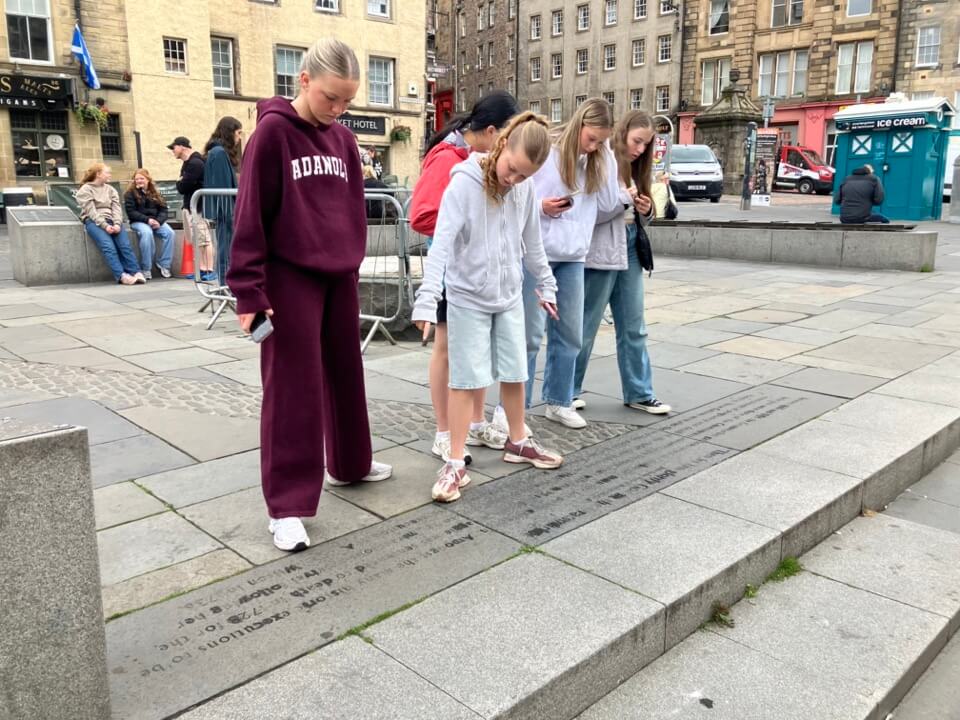
The setup was straightforward. Pupils worked in small groups, each with a teacher chaperone, and used their phones to follow clues around central Edinburgh.
It gave them a structured reason to explore the city, talk to each other, look closely at their surroundings and solve problems together.
Why George Heriot’s uses it
George Heriot’s has now used the treasure hunt for three years.
The teacher I spoke to said it gives pupils “a nice opportunity” to bond in a small group and with a teacher.
He also said it helps pupils see more of the area they go to school in and live in, including bits of history and local detail they may have walked past many times without really noticing.
That is a big part of why the activity works well for schools.
It is not something that could just as easily happen in a sports hall or classroom. The treasure hunt is tied to the city itself. Pupils have to look closely at real streets, buildings, statues, signs and small details, then work together to make sense of what they find.
So it is structured enough that pupils are not just being sent out for a wander. But it is relaxed enough for conversation, teamwork and confidence to develop naturally along the way.
What pupils said
One pupil described the activity as going around Edinburgh, getting “different clues and hints”, and trying to “figure out what the question was”.
Another said the group used “teamwork, leadership, and just paying attention and communicating with each other”.
A pupil also said that if you “actually look closely”, you can find interesting things in places you would not have thought about before.
Which, to be fair, is a pretty good summary of the whole thing.
What it looked like in practice
The format was simple, but it created plenty of interaction.
Pupils started by scanning a QR code, then followed clues around the city with a teacher. At each stop, they had to look closely, discuss possible answers and agree what to submit.
There was a friendly competitive edge too. Groups wanted to do well, check their score and see how they were getting on, but it never felt high-pressure.
Some clues were solved quickly. Others needed a bit more searching, re-reading and debate.
That was part of the point. The pupils were not just walking through the city. They were paying attention to it, questioning what they saw, and working out the answers together.
Why it works well for schools
The treasure hunt gives pupils a clear shared task.
They are not being asked to perform, present or compete in a way that feels intense. They are simply trying to find things, discuss possible answers and make decisions as a team.
That makes it a useful fit for activity weeks, end-of-term trips and city visits.
It also keeps the logistics simple, which is not a small thing when you are organising a school trip.
There is no host to wait for, no venue hire, and no specialist equipment. Each group just needs access to a phone, and staff can accompany pupils as they normally would on a school outing.
For George Heriot’s, it has become a simple way to get pupils out into Edinburgh, working together, and noticing the city properly.